The Shape of a Sphere
Source status: Classical solved theorem · Archival reconstruction · No new-proof claim.
GitHub equation reader; automatically generated from the original manuscript. The illustrated documentary has the canonical layout, figures and reader controls. This is not independent mathematical or publication certification.
A note to the reader
Wonder first; authority always visible
This web edition is meant to be entered as one enters an old observatory: first by wonder, then by instruments, and finally by exact measurement. Its illuminated plates are aids to orientation and memory. They are not proof diagrams. The prose, equations, cited sources, and explicit trust labels govern every mathematical claim.
The Poincaré theorem is solved. This volume reconstructs the classical Hamilton–Perelman route for a broad reader; it does not offer a new proof, an independent verification of the nonlinear estimates, or a machine-checked formalization of Ricci flow with surgery.
The committed
.tex
file is a source record. The checksum-locked complete illustrated source bundle is the authoritative source artifact; the checksum-locked PDF is the rendered edition. Both are currently identified as
metadata_only
, without an asserted stable public release locator.
Established theorem
Every closed, connected, simply connected topological three-manifold is homeomorphic to the three-sphere.
Category guardrail
Pictures of two-dimensional spheres and tori are analogies. The theorem concerns three-manifolds. Passing among topological, PL, smooth, and Riemannian categories uses dimension-three theorems; it is not definitional.
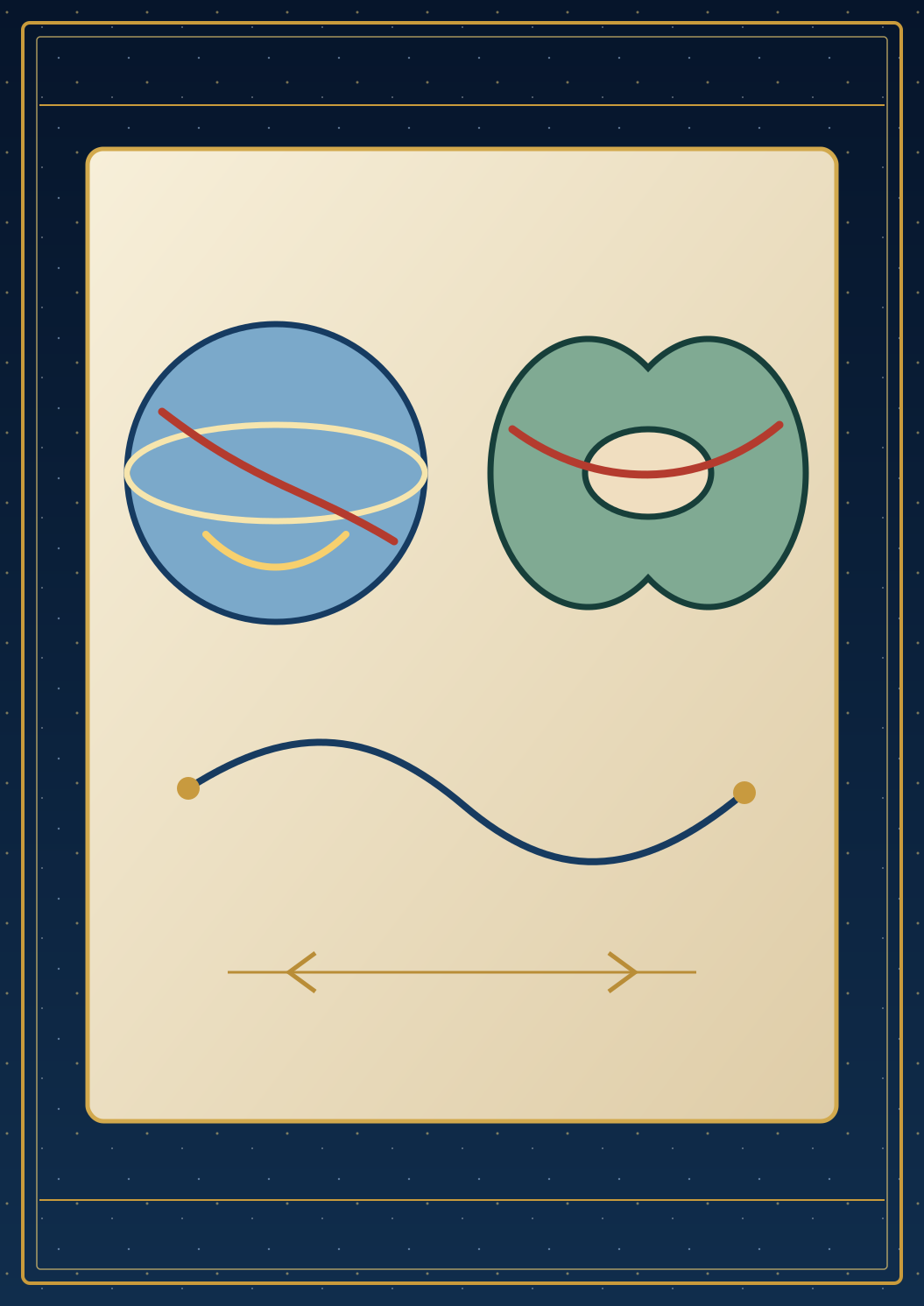
Plate I. Plate I The question hidden inside a loop Pedagogical orientation only. The sphere and torus are lower-dimensional models of the loop obstruction. Illustration. Alt text: A lower-dimensional analogy comparing contractible loops on a sphere with a loop trapped around a torus hole.
Chapter I
The question hidden inside a loop
Imagine living in a universe with no outside. There is no surrounding room from which to inspect its shape. You may travel, draw loops, stretch them, and ask whether they can be pulled tight without tearing the world. Topology begins from this austere freedom: it studies what survives every continuous deformation.
A space is
simply connected
when every loop can be contracted continuously to a point. On the ordinary sphere, a loop can slide and shrink until nothing remains. On a torus, a loop winding through the central hole cannot disappear. The loop remembers a global obstruction that no local inspection reveals.
The theorem asks whether this loop test completely recognizes the three-sphere among closed three-dimensional worlds:
The hypothesis is terse. The conclusion is absolute. Yet the bridge between them cannot be built from pictures alone. A loop is one-dimensional; a three-manifold may hide its complexity in nested surfaces, prime factors, and geometric regions that only become visible after one equips it with a metric.
Topology asks what the world is. Geometry lends us a way to make the world answer.
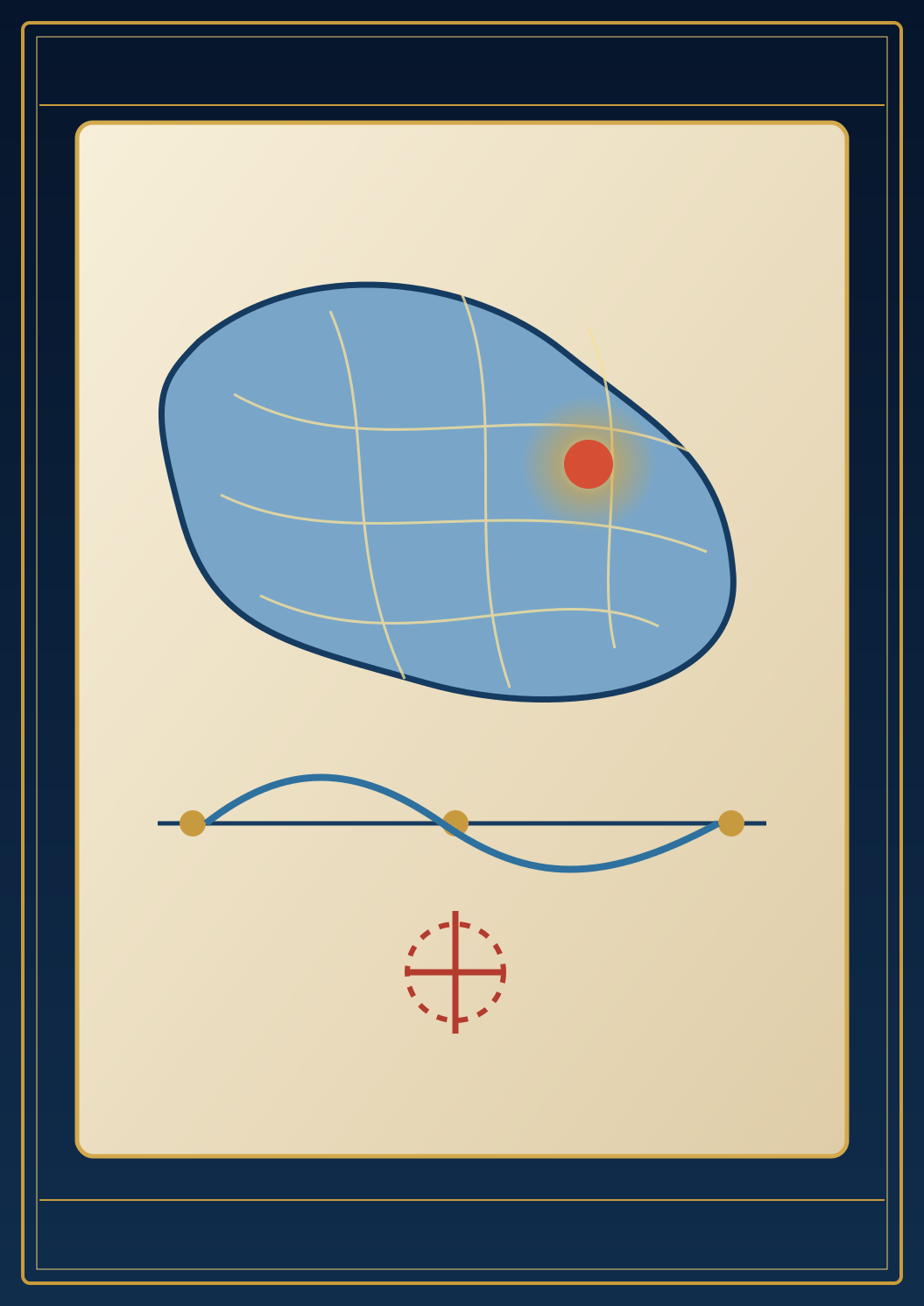
Plate II. Plate II When geometry becomes an engine The metric evolves; curvature concentrates; analysis must distinguish harmless smoothing from singular behaviour. Illustration. Alt text: A curved geometry smoothing under Ricci flow while concentrated curvature signals a possible singularity.
Chapter II
When geometry becomes an engine
Richard Hamilton’s proposal was to place a Riemannian metric on the manifold and let that metric evolve by
Ricci flow
:
The equation is often compared with heat diffusion. Uneven curvature tends to spread and smooth. This is useful, but incomplete: nonlinear geometry can concentrate faster than diffusion can disperse it. A thin neck may form; curvature may blow up; the classical flow may cease to exist in finite time.
Perelman supplied the controls that turn this apparent failure into information. Entropy and reduced-volume quantities restrain collapse. Blow-up limits reveal ancient geometric models. Canonical-neighbourhood theorems say that regions of sufficiently high curvature resemble a controlled catalogue—necks, caps, and compact positively curved pieces—at the relevant scale.
01Choose a metric02Run Ricci flow03Classify high curvature04Continue through surgeryAnalytic import
Entropy monotonicity, no local collapse, ancient-solution structure, canonical neighbourhoods, and surgery continuation are deep imported theorems. The web presentation explains their role but does not independently prove them.
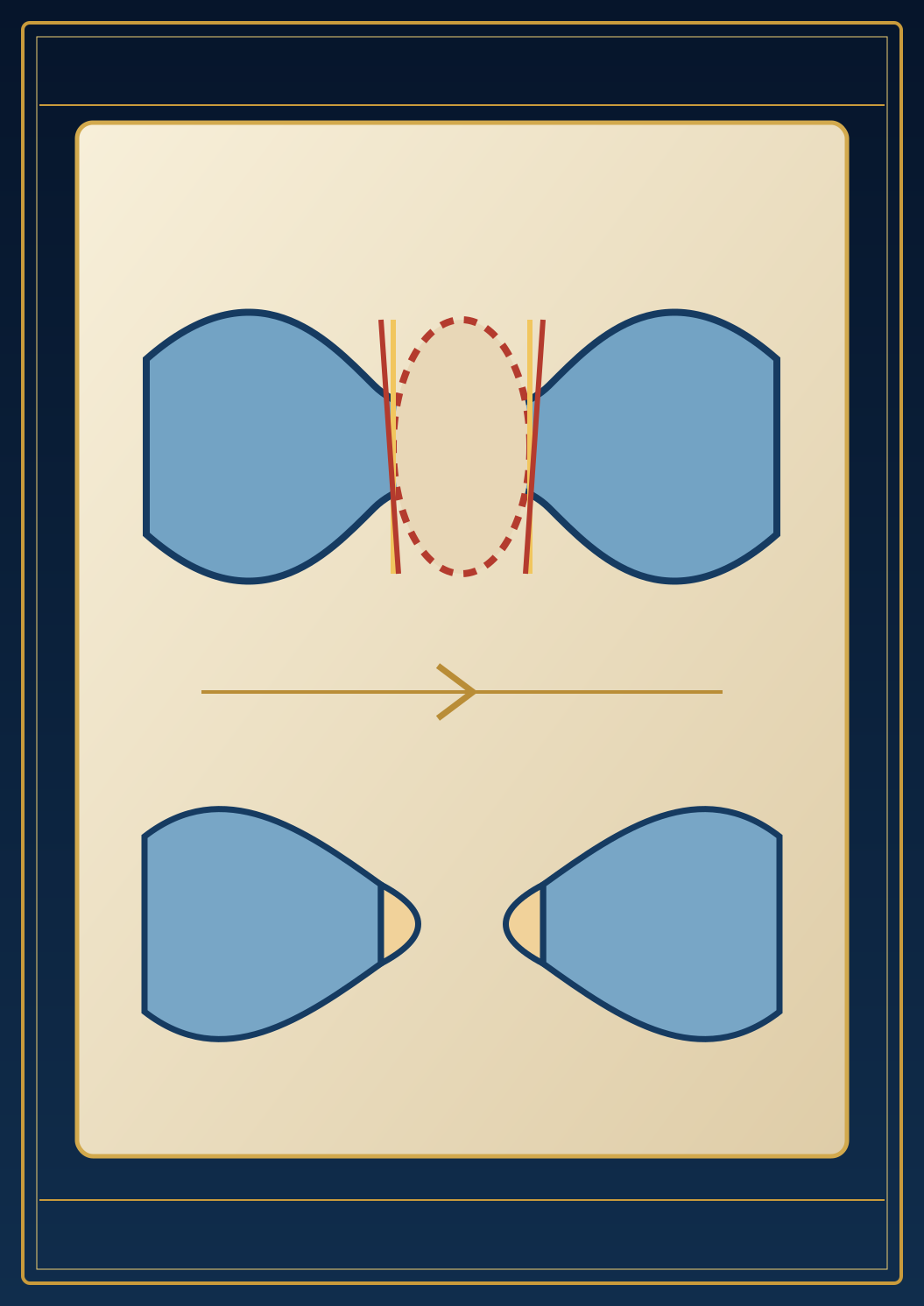
Plate III. Plate III The craft of controlled surgery Surgery is not topology-preserving. Its exact topological effect must be recorded and later reversed. Illustration. Alt text: A neck-like high-curvature region is cut along controlled spheres and replaced by standard caps.
Chapter III
The craft of controlled surgery
Once a high-curvature neck is known to be close to a standard cylinder, the flow can be stopped just before catastrophe. One cuts across carefully chosen two-spheres, removes the most singular ends, attaches standard caps, and restarts the evolution on the surviving components.
The word surgery can sound like an informal repair. Mathematically it is a theorem-bound operation with scale hierarchies, curvature thresholds, cap models, noncollapsing estimates, and a finite catalogue of topological transitions. A separating sphere cut records a connected-sum decomposition. A nonseparating cut records an \(S^2\!\times S^1\) -type factor in the orientable setting. Discarded components must belong to permitted, source-certified classes.
Bookkeeping theorem
Conditional on the imported geometric event relation, a finite source-bound surgery history can be read backward to reconstruct a connected-sum expression for the original manifold.
Extinction is not classification
Many nontrivial spherical space forms also become extinct under Ricci flow. Finite extinction alone does not imply that the initial manifold was \(S^3\); the backward factor reconstruction and the fundamental-group argument are indispensable.
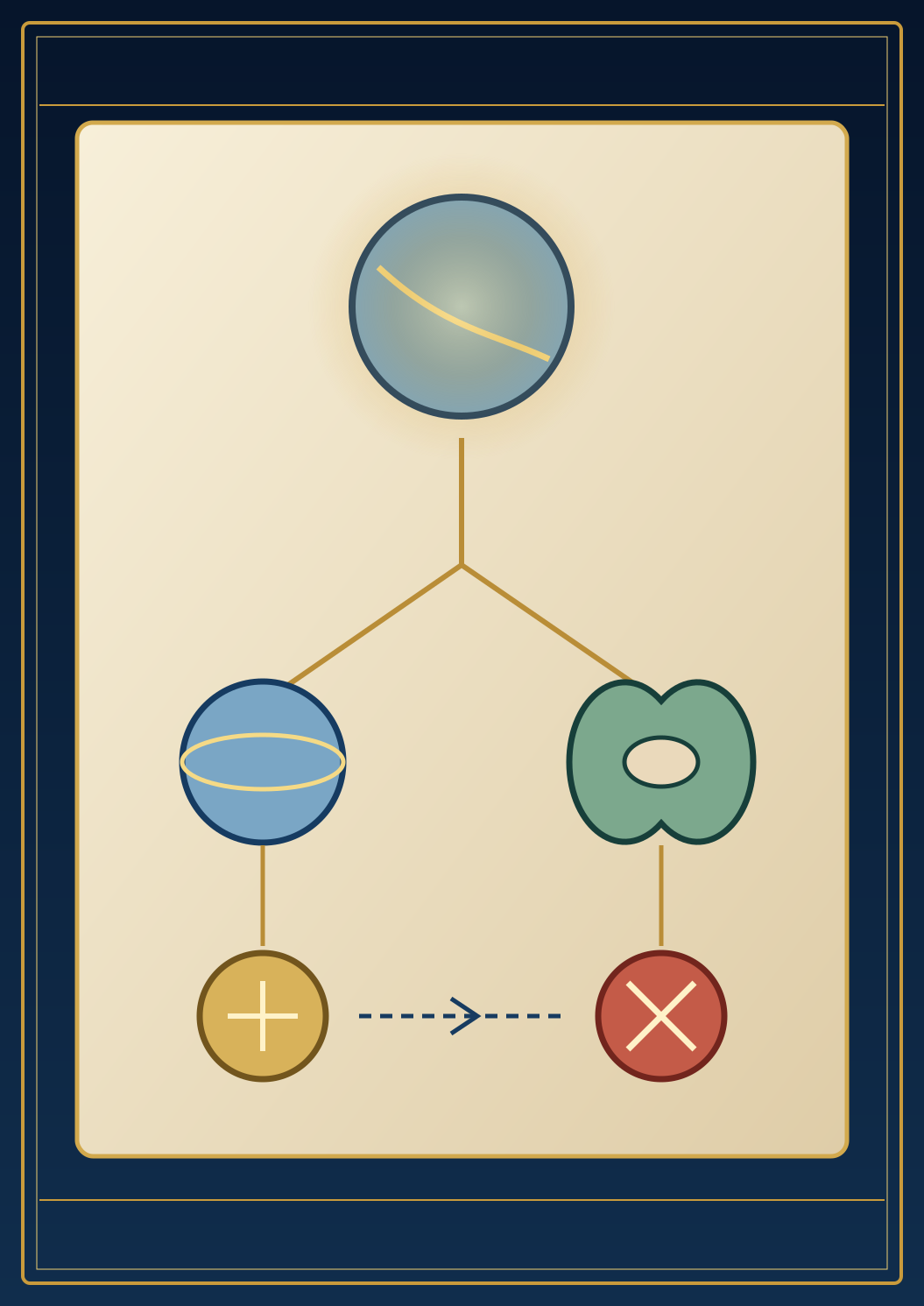
Plate IV. Plate IV Extinction, reversal, and the sphere Local finiteness plus finite extinction yields a finite history. Reverse induction restores the initial topology. Illustration. Alt text: A finite surgery history is read backward into factors, after which simple connectivity eliminates nontrivial factors and leaves the sphere.
Chapter IV
Extinction, reversal, and the sphere
Perelman proved finite extinction for the relevant class of three-manifolds: after finite time the surgery flow has no surviving component. This endpoint is useful because a finite process can be reversed. Local finiteness of surgery times on each bounded interval, combined with a finite extinction time, gives a finite event history.
Reading the history backward expresses the initial manifold as a connected sum of standard terminal and discarded factors. The final sieve is algebraic. By the Seifert–van Kampen theorem, connected sum becomes free product at the level of fundamental groups. Every nontrivial spherical space-form factor contributes a nontrivial finite group; every \(S^2\!\times S^1\) factor contributes an infinite cyclic group. If the original fundamental group is trivial, none of these nontrivial factors can remain.
What survives is the three-sphere.
The proof does not stare directly at the sphere. It governs a process until every alternative has nowhere left to hide.
Technical appendix A
Definitions and category bridges
A
closed
manifold is compact and has empty boundary. A
topological three-manifold
is Hausdorff, second countable, and locally homeomorphic to \(\mathbb{R}^3\). In dimension three, classical triangulation and smoothing theorems permit the topological manifold to be treated through PL and smooth structures, after which one chooses a Riemannian metric.
The conclusion produced by the analytic route is naturally smooth: the simply connected component is diffeomorphic to \(S^3\). Forgetting smooth structure gives the required homeomorphism. These arrows are mathematical theorems, not changes of vocabulary.
| Interface | Role | Status in this edition |
|---|---|---|
| Topological \(\to\) PL \(\to\) smooth | permits Ricci-flow input | imported classical theorem |
| Smooth \(\to\) Riemannian | choose initial metric | established construction |
| Diffeomorphic \(\to\) homeomorphic | returns to Clay statement | immediate implication |
Technical appendix B
Ricci flow and its controls
Under parabolic rescaling, curvature and time transform together. The surgery parameters therefore form a hierarchy rather than a collection of universal constants: a canonical-neighbourhood accuracy is fixed; associated curvature controls are obtained; surgery tolerances are chosen sufficiently small; cutting and trigger scales are then derived. Silent interchange of local, stagewise, and global constants is a common source of false proofs.
The analytic spine is:
- short-time existence for the initial metric;
- entropy and reduced-geometry monotonicity;
- no local collapse at controlled scales;
- compactness and structure of blow-up limits;
- canonical neighbourhoods at high curvature;
- construction and continuation of Ricci flow with surgery;
- finite extinction under the topological hypothesis.
The full estimates belong to Perelman’s papers and detailed expositions by Kleiner–Lott and Morgan–Tian.
Technical appendix C
Claim-level trust matrix
| Claim | Trust class | Qualification |
|---|---|---|
| Poincaré theorem | established | classical solved theorem |
| Top/PL/Diff bridge in dimension three | imported | classical category theorem |
| Ricci-flow analytic core | imported | not independently reconstructed here |
| Finite extinction route | imported | source-normalized to Perelman and Morgan–Tian |
| Finite-event backward evaluator | kernel-checked, bounded | conditional on imported event equations |
| Illuminated plates | pedagogical | never authoritative proof diagrams |
| New proof or novelty | not claimed | explicitly excluded |
Final claim boundary
This web edition changes presentation, not theorem strength. It adds responsive reading, searchability, accessibility, source links, plate enlargement, reading-position memory, and print treatment. It does not alter the archived mathematical disposition of PC-001.
Sources
The governing literature
Richard S. Hamilton, “Three-manifolds with positive Ricci curvature,” Journal of Differential Geometry 17 (1982), 255–306.
Grisha Perelman, The entropy formula for the Ricci flow and its geometric applications (2002).
Grisha Perelman, Ricci flow with surgery on three-manifolds (2003).
Grisha Perelman, Finite extinction time for the solutions to the Ricci flow on certain three-manifolds (2003).
Bruce Kleiner and John Lott, Notes on Perelman’s papers, version 5 (2013).
John W. Morgan and Gang Tian, Ricci Flow and the Poincaré Conjecture (2007).
Edition record
This is the reference implementation for the Grand Challenge Library web format. Its content schema, plate contract, scoped palette, responsive rules, accessibility landmarks, interactive controls, and print treatment are intended for reuse by the remaining documentary volumes.
The web edition is derivative. The source record identifies the release-class artifacts; the checksum-locked complete illustrated source bundle is authoritative. MathJax 3.2.2 is a version-pinned network enhancement, and the source TeX remains present when it is unavailable.
Web-edition dataReusable schemaSource record
Rendered PDF
18,426,001 bytes ·
0e1499ee13a6966a3b190b850b6acd2db647952826c54b3abc575d607a2f6ea4
·
metadata_only
Complete LaTeX source
59,039 bytes ·
58dc94e7296bdfad5f31720f2e3b53be4097ff356f6c83a58db769db357e7b9d
·
metadata_only
Authoritative complete illustrated source bundle
42,084,814 bytes ·
670cb6a4d63ed79a21fbbe70857bd0d46ad63ce546c92d320de7e39f06612771
·
metadata_only