The Geometry of Hidden Harmony
Source status: Open Millennium Prize Problem · HC-001 · No solution claimed.
GitHub equation reader; automatically generated from the original manuscript. The illustrated documentary has the canonical layout, figures and reader controls. This is not independent mathematical or publication certification.
A note to the reader
How to Read the Harmony
A complex algebraic variety may be studied as equations, topology, and complex geometry. Hodge theory decomposes its cohomology into analytic types; algebraic cycles produce special classes. The stained-glass diamonds are orientation devices. Rational coefficients, smooth projectivity, the cycle-class map, and known counterexamples govern the claim.
Edition status:
Open Millennium Prize Problem; rational projective statement; no algebraicity proof claim.
Open conjecture
For a smooth projective complex variety \(X\), every rational class in \(H^{2p}(X,\mathbb Q)\cap H^{p,p}(X)\) is conjectured to be a rational linear combination of codimension- \(p\) algebraic cycle classes.
Claim boundary
The rational, smooth, projective, and complex hypotheses are structural. Integral and unrestricted compact Kähler extensions are false.
Plate I. Plate I How a shape remembers Pedagogical orientation only. Cohomology and Poincaré duality govern the claim. Illustration. Alt text: Cycles thread through a complex geometric world while cohomology records their global traces.
Chapter I
How a Shape Remembers
Cohomology records global holes through closed differential forms. A codimension- \(p\) subvariety has real codimension \(2p\), so its fundamental class lives in even-degree cohomology.
Definition
A smooth projective complex variety is a nonsingular projective algebraic variety over \(\mathbb C\). Projectivity supplies the polarization and algebraic category required by the conjecture.
The cycle-class map forgets much geometry: distinct cycles can share a class, and homologically trivial cycles map to zero.
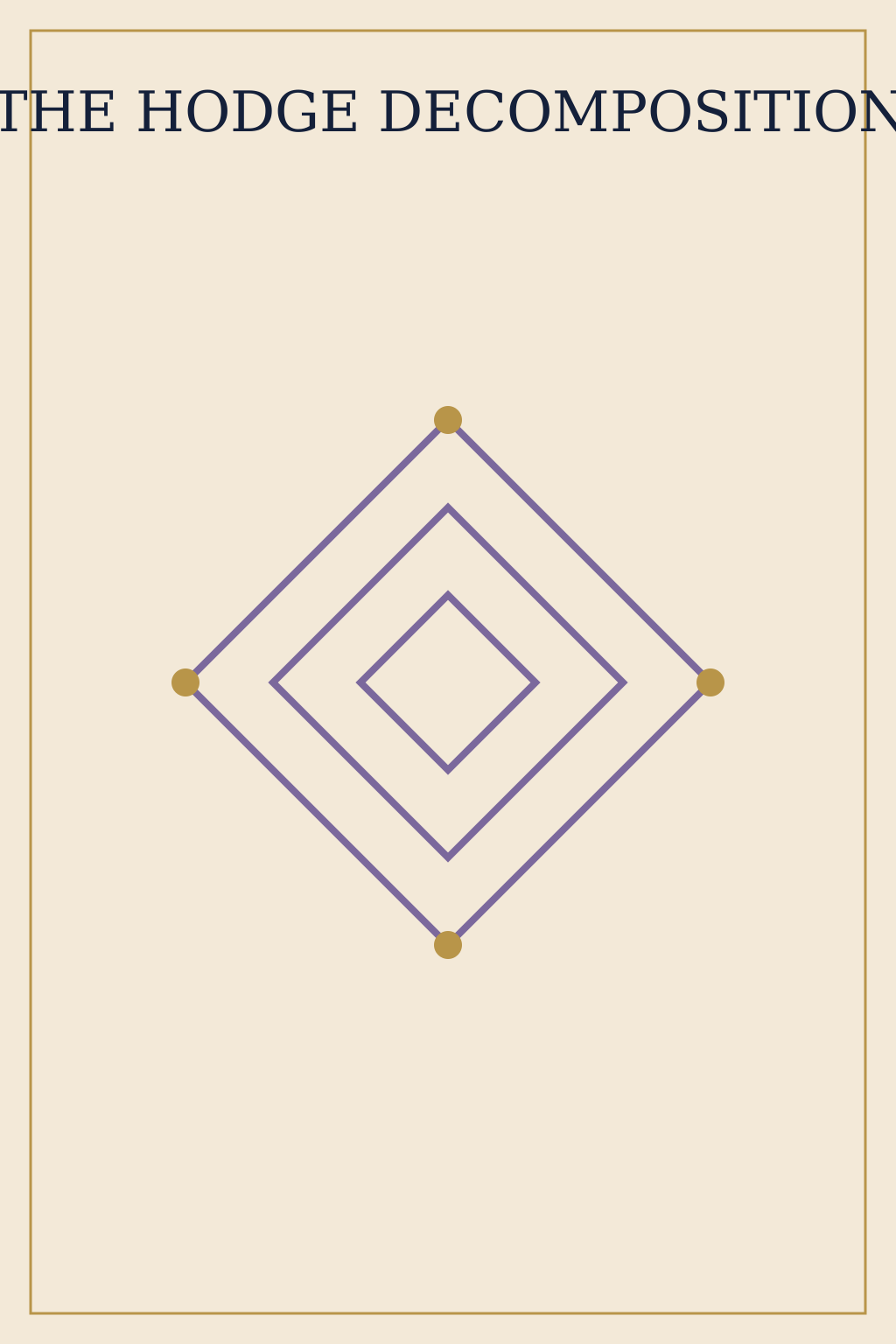
Plate II. Plate II The Hodge decomposition Pedagogical orientation only. The direct-sum decomposition governs the types. Illustration. Alt text: A luminous Hodge diamond separates cohomology into conjugate bidegrees.
Chapter II
The Hodge Decomposition
For a compact Kähler manifold,
Imported established theorem
Harmonic theory gives the Hodge decomposition. Algebraic cycles necessarily yield classes of type \((p,p)\); the higher-codimension converse for rational classes is the open step.
Symmetry of the Hodge diamond is theorem-level structure, not a construction of algebraic representatives.
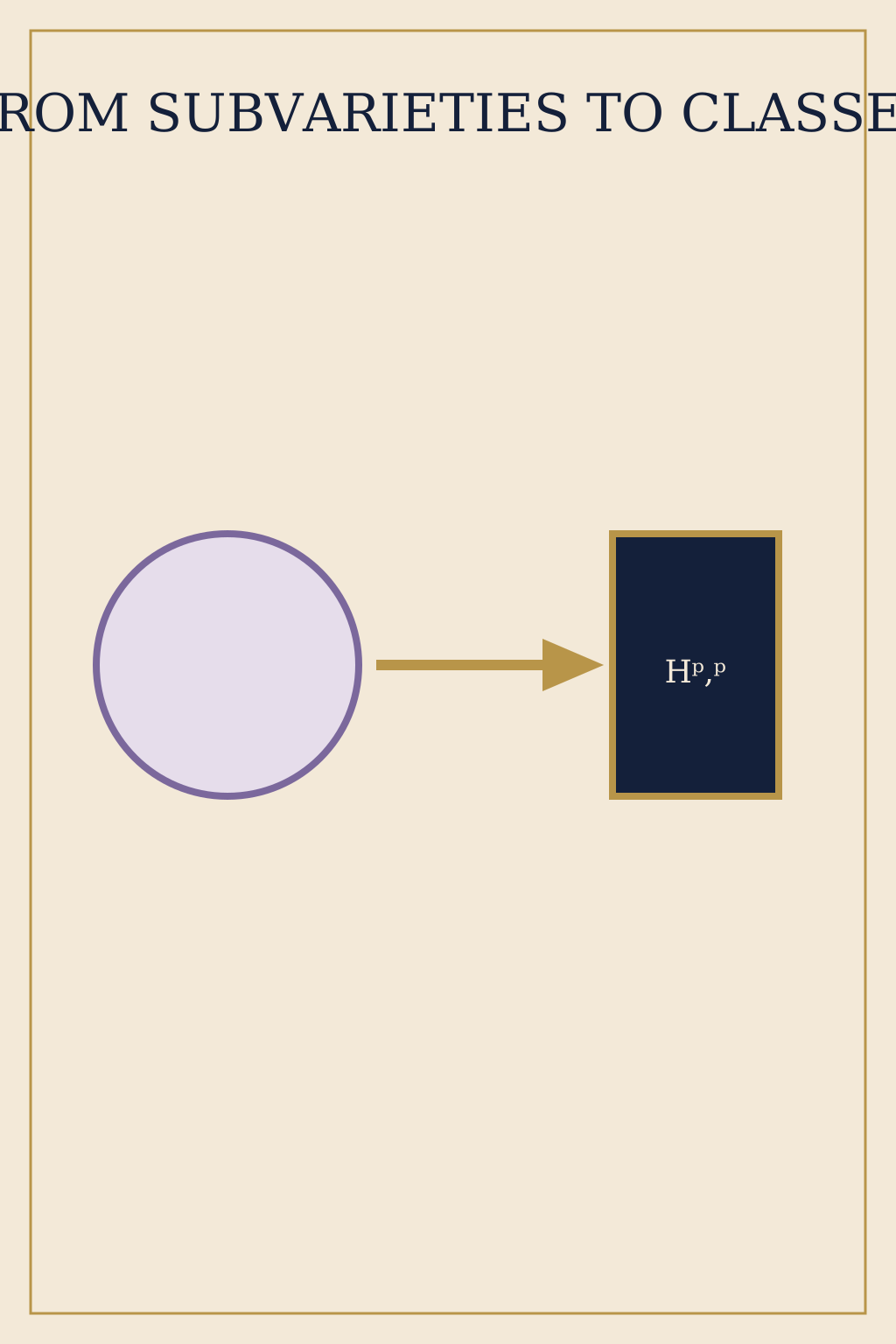
Plate III. Plate III From subvarieties to classes Pedagogical orientation only. The cycle-class map is many-to-one and need not be surjective. Illustration. Alt text: Algebraic subvarieties map through the cycle-class map into rational Hodge classes.
Chapter III
Algebraic Cycles and Their Classes
Let \(Z^p(X)\) be generated by irreducible codimension- \(p\) subvarieties. The cycle-class map is
Definition
A rational Hodge class is an element of \(H^{2p}(X,\mathbb Q)\) whose complexification lies in \(H^{p,p}(X)\).
Chow groups and Abel–Jacobi invariants refine information lost in ordinary cohomology, but they do not make every Hodge class algebraic by definition.
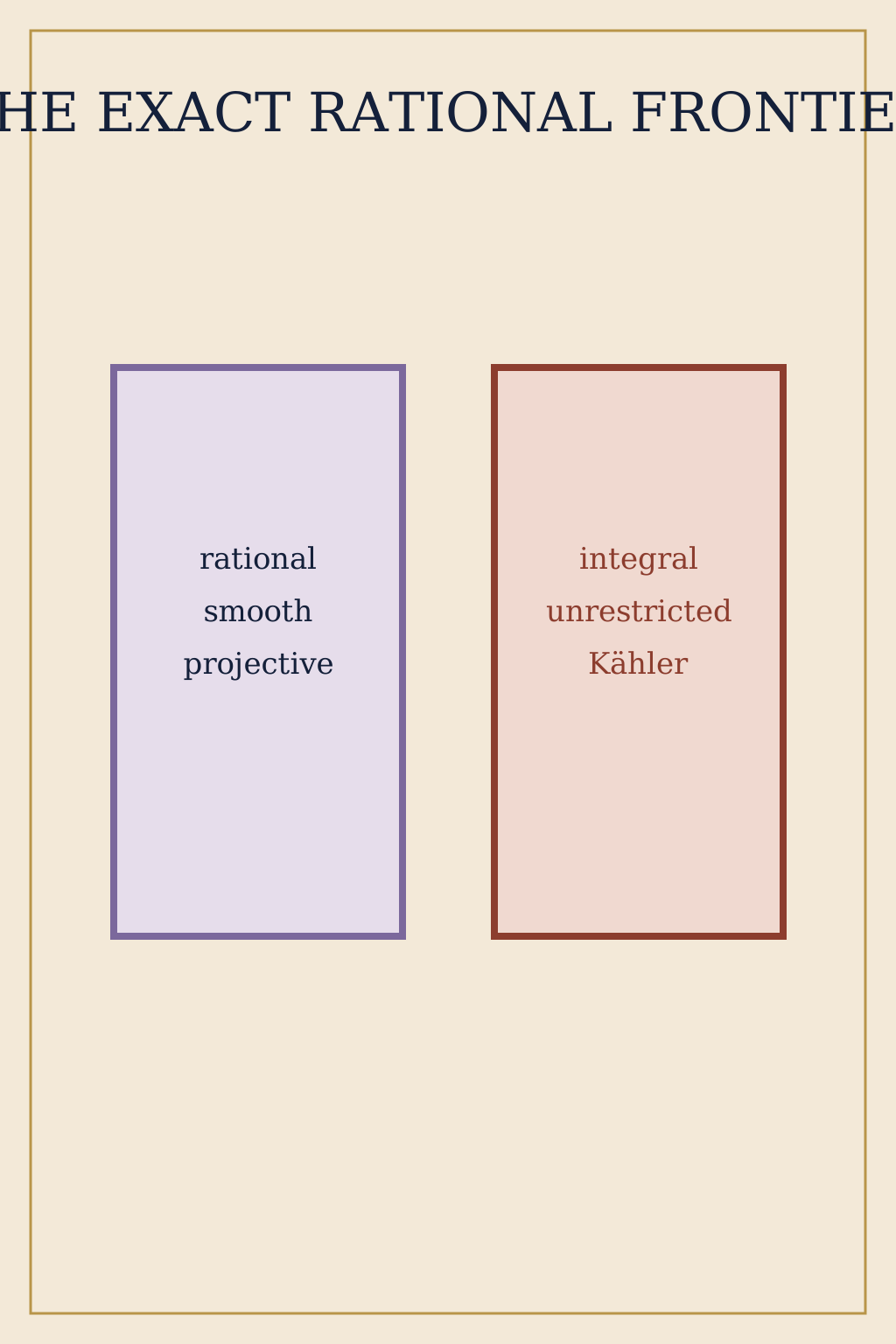
Plate IV. Plate IV The exact rational frontier Pedagogical orientation only. Category and coefficient restrictions are theorem-critical. Illustration. Alt text: Known divisor and low-dimensional terrain is separated from false integral and unrestricted Kähler variants.
Chapter IV
The Exact Rational Conjecture
The left side is generated geometrically; the right side is selected analytically and arithmetically.
Coefficient and category guardrail
The integral conjecture is false, and the analogous statement for arbitrary compact Kähler manifolds is false. Replacing \(\mathbb Q\) by \(\mathbb Z\), or projective by Kähler, changes the theorem.
Chapter V
Known Islands and False Extensions
Established low-dimensional terrain
Lefschetz \((1,1)\) proves codimension one. Together with duality and the available codimensions, the rational Hodge conjecture follows for smooth projective varieties of complex dimension at most three.
Dimension four contains genuine middle-dimensional codimension-two classes. Hodge loci, the Tate conjecture, Mumford–Tate groups, and motives are connected programmes, not interchangeable statements.
Topology keeps the memory. Hodge theory sorts the memory. Algebraic geometry asks who wrote it.
Technical appendix A
Category and Coefficient Restrictions
The statement fixes smooth projective \(X/\mathbb C\), singular cohomology with rational coefficients, Hodge decomposition, and algebraic cycles of fixed codimension. Singular or open varieties require different structures; integral coefficients retain torsion.
Technical appendix B
The Cycle-Class Map
For irreducible \(Z\subset X\), Poincaré duality gives \([Z]\in H^{2p}(X,\mathbb Z)\). Algebraicity implies Hodge type \((p,p)\). Surjectivity after tensoring with \(\mathbb Q\) is the conjecture; injectivity is false and belongs to finer cycle theories.
Technical appendix C
Lefschetz and the Low-Dimensional Boundary
The exponential sequence and Lefschetz theorem give \(c_1:\mathop{\mathrm{Pic}}(X)\twoheadrightarrow H^2(X,\mathbb Z)\cap H^{1,1}(X)\). The argument does not automatically reach middle cohomology in dimension four or higher.
Technical appendix D
Hodge Loci, Motives, and Trust Matrix
| Claim | Trust class | Qualification |
|---|---|---|
| Hodge decomposition | imported established | compact Kähler theorem |
| Algebraic cycles have \((p,p)\) classes | established | necessary direction |
| Lefschetz \((1,1)\) | imported established | codimension one |
| Dimension at most three | established consequence | low-dimensional boundary |
| Integral Hodge conjecture | false in general | not the Clay statement |
| Unrestricted Kähler analogue | false in general | projectivity essential |
| General rational projective conjecture | open | dimension four already open |
| Tate/Mumford–Tate/motives | adjacent programmes | not identical |
| Illuminated plates | pedagogical | never authoritative cycle diagrams |
Final claim boundary
This edition does not prove algebraicity of a new Hodge class, settle a new family, or transfer an arithmetic or motivic statement into the general complex conjecture.
Sources and programme crosswalk
Governing literature and campaign record
Clay Mathematics Institute: Hodge Conjecture.
Pierre Deligne, official problem description.
Atiyah and Hirzebruch, integral counterexamples.
Cattani, Deligne, and Kaplan, Hodge loci.
Programme links: Domain 03 · claim-authority record · campaign artifacts · review records
Edition record
This browser-native edition uses the immutable Poincaré reference contract and shared open-problem status vocabulary. Native SVG plates are pedagogical; semantic HTML carries the coefficient and category restrictions.
The committed pointer is a source record; the checksum-locked complete illustrated source bundle is the authoritative source artifact. MathJax 3.2.2 is a version-pinned network enhancement, and the source TeX remains present when unavailable.
Web claim boundary: Browser-native, source-normalized exposition of the rational Hodge conjecture for smooth projective complex varieties. Low-dimensional cases, numerical coincidence, integral classes, arbitrary compact Kähler manifolds, Hodge loci, Abel–Jacobi invariants, the Tate conjecture, Mumford–Tate theory, and motivic heuristics are not promoted to the general algebraicity statement.
Web-edition dataReusable schemaSource recordArtifact manifest
Rendered PDF
19,725,126 bytes ·
375a142a6a11492922130e555c37d308734aec0f64fc3a10d205f1863d348d59
·
metadata_only
Complete LaTeX source
57,896 bytes ·
10a93fbe472c76d6e11b78fa3221c96cc615fe014fa80b70d9bc2feec7ee2690
·
metadata_only
Authoritative complete illustrated source bundle
19,663,963 bytes ·
be1952b50d2938f061e763f3f7c8150c8957b95710ebce2f6ca3b11210085746
·
metadata_only