The Hidden Music of Elliptic Curves
Source status: Open Millennium Prize Problem · BSD-001 · No proof claimed.
GitHub equation reader; automatically generated from the original manuscript. The illustrated documentary has the canonical layout, figures and reader controls. This is not independent mathematical or publication certification.
A note to the reader
Exact objects first; the open boundary always visible
Birch and Swinnerton–Dyer links the rational-point structure of an elliptic curve to the behaviour of its \(L\) -function at \(s=1\). The conjecture remains open in general.
This browser edition is a derivative, source-normalized exposition. Its numbered plates render exact mathematical objects, exact finite computations, or quantified theorem structure whenever the adjacent concept permits it. Wolfram Language is the canonical semantic-master language for the revised plates; the committed web graphics are deterministic publication derivatives. The plates are pedagogical, not proof evidence. Definitions, equations, source links, campaign records, and trust labels govern the mathematics.
Edition status:
Open Millennium Prize Problem; documentary exposition; no proof claim.
Open conjecture
For every elliptic curve \(E/\mathbb{Q}\), BSD predicts \(\mathop{\mathrm{rank}}E(\mathbb{Q})=\mathop{\mathrm{ord}}_{s=1}L(E,s)\). The universal leading-term formula and general finiteness of \(\mathop{\mathrm{Sha}}(E/\mathbb{Q})\) remain open.
Claim boundary
Finite computation, parity, Selmer bounds, family averages, one-prime results, \(p\) -adic formulas, and analytic-rank-zero-or-one theorems do not by themselves establish the universal complex conjecture.
Chapter I
Rational points: one exact doorway
An elliptic curve over \(\mathbb{Q}\) can be written in short Weierstrass form
Definition
An elliptic curve over \(\mathbb{Q}\) is a smooth projective genus-one curve equipped with a rational base point. A short Weierstrass model has nonzero discriminant.
Its real points form continuous curves. Its rational points form a finitely generated abelian group, but finding all generators can be difficult.
The congruent-number problem gives a concrete entry point. A positive integer \(n\) is the area of a rational right triangle exactly when
has a rational point of infinite order. For \(n=5\), the exact point
lies on \(E_5:y^2=x^3-25x\) and corresponds to a rational right triangle with sides \(3/2\), \(20/3\), and \(41/6\). Its area is exactly \(5\).
Finite-window guardrail
Displaying a real curve and one rational point does not determine the Mordell–Weil rank and does not prove BSD.
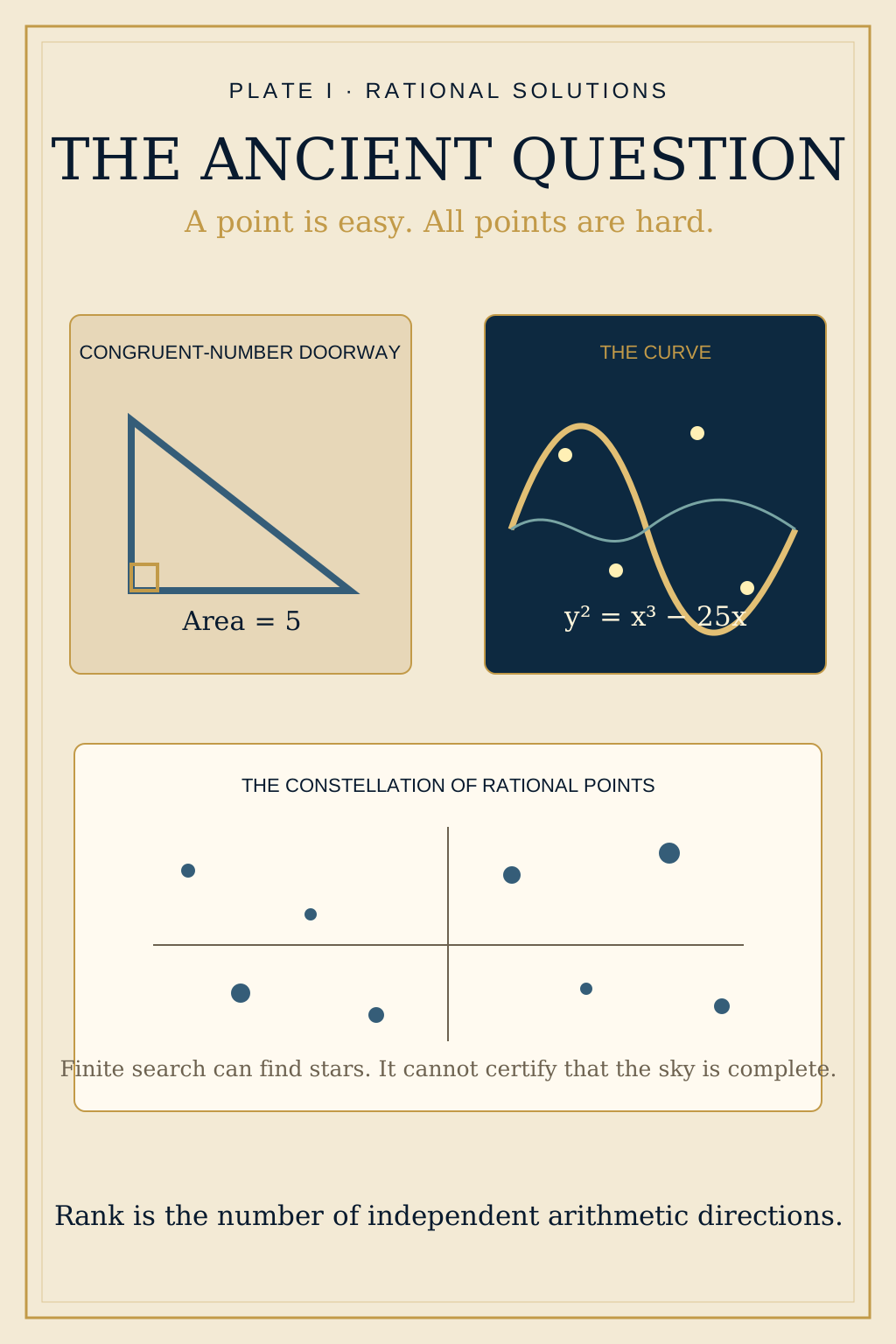
Plate I. Plate I The ancient question of rational solutions Fallback predecessor plate. With JavaScript enabled, the reviewed exact-object successor is activated at this stable source reference. Illustration. Alt text: An illustrated map from rational right triangles and cubic curves to sparse rational points, torsion, rank, and the limits of finite search.
Chapter II
The chord–tangent group law
A nonsingular cubic carries an addition law. A line through two points meets the cubic a third time; reflecting that third intersection across the horizontal axis gives the sum. A tangent supplies doubling.
Plate II fixes one exact rational example on
The points \(P=(0,1)\) and \(Q=(1,1)\) lie on \(E\). Their horizontal chord \(y=1\) meets \(E\) again at \(R=(-1,1)\). Reflection gives
Established theorem · Mordell–Weil
\(E(\mathbb{Q})\cong\mathbb{Z}^r\oplus E(\mathbb{Q})_{\mathrm{tors}}\). The integer \(r\) is the algebraic rank.
Canonical heights measure the independent free directions. The determinant of their height pairing is the regulator that appears in the strong BSD formula.
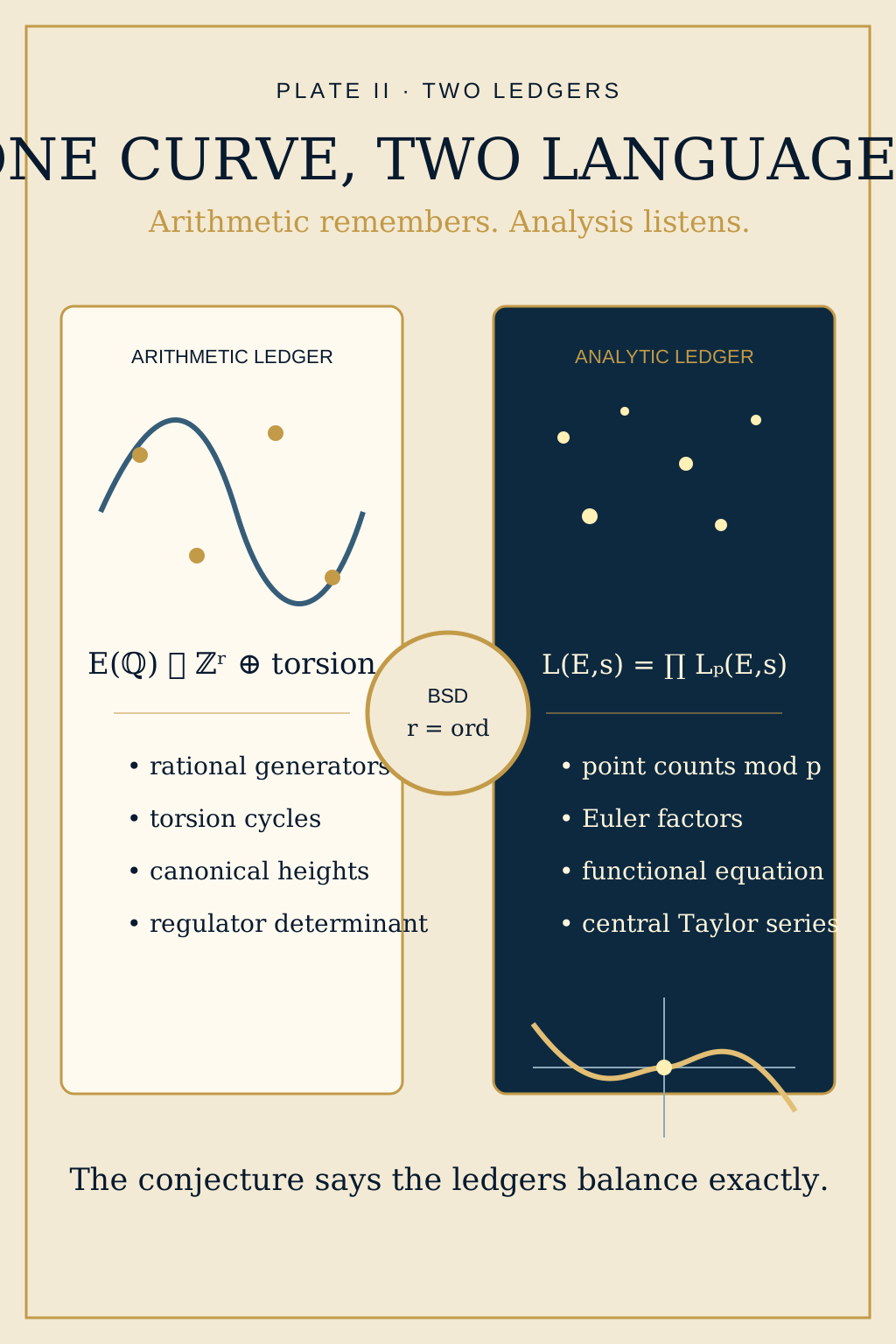
Plate II. Plate II Two ledgers in the same hand Fallback predecessor plate. With JavaScript enabled, the reviewed exact chord–tangent successor is activated at this stable source reference. Illustration. Alt text: A paired arithmetic and analytic panorama links the Mordell–Weil group of rational points to the vanishing of an elliptic-curve L-function.
Chapter III
Counting at a good prime
Reduce a suitable integral equation modulo a prime \(p\). At a prime of good reduction define
and
For \(E_5:y^2=x^3-25x\) at \(p=13\), exact enumeration gives \(19\) affine solutions. Including the point at infinity,
Hence
The finite sample in Plate III is exact for the displayed primes. It is not an estimator of rank.
Imported established result · modularity
Every elliptic curve over \(\mathbb{Q}\) is modular. Its \(L\) -function therefore has analytic continuation and a functional equation centred at \(s=1\).
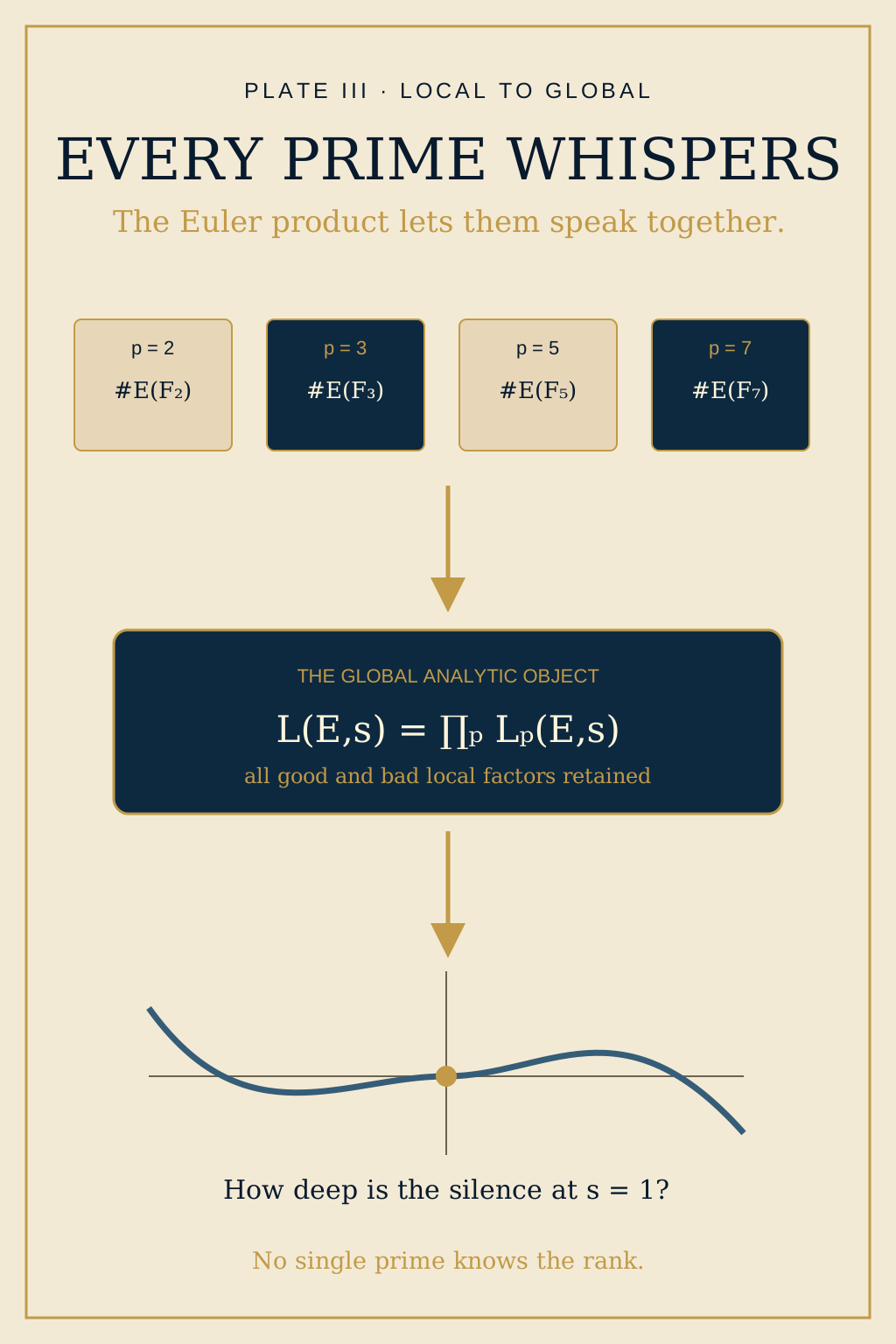
Plate III. Plate III From prime counts to the central point Fallback predecessor plate. With JavaScript enabled, the reviewed exact finite-field successor is activated at this stable source reference. Illustration. Alt text: Prime-by-prime point counts are assembled into Euler factors and an L-function whose behaviour at the central point is compared with rank.
Chapter IV
The strong BSD ledger
The rank statement is
The strong form predicts the first nonzero Taylor coefficient as an arithmetic factorization. If \(r=\mathop{\mathrm{rank}}E(\mathbb{Q})\) and \(\mathop{\mathrm{Sha}}(E/\mathbb{Q})\) is finite, then under the displayed normalization,
The factors have different jobs. \(\Omega_E\) is an archimedean period; the regulator measures the Mordell–Weil lattice; \(c_p\) records bad-prime component data; torsion contributes a finite denominator; and \(\mathop{\mathrm{Sha}}\) measures locally soluble torsors that may fail globally.
Three obligations, not one slogan
Rank equality, finiteness of \(\mathop{\mathrm{Sha}}\), and the normalized leading-term identity are logically distinct. Establishing one does not silently establish the others.
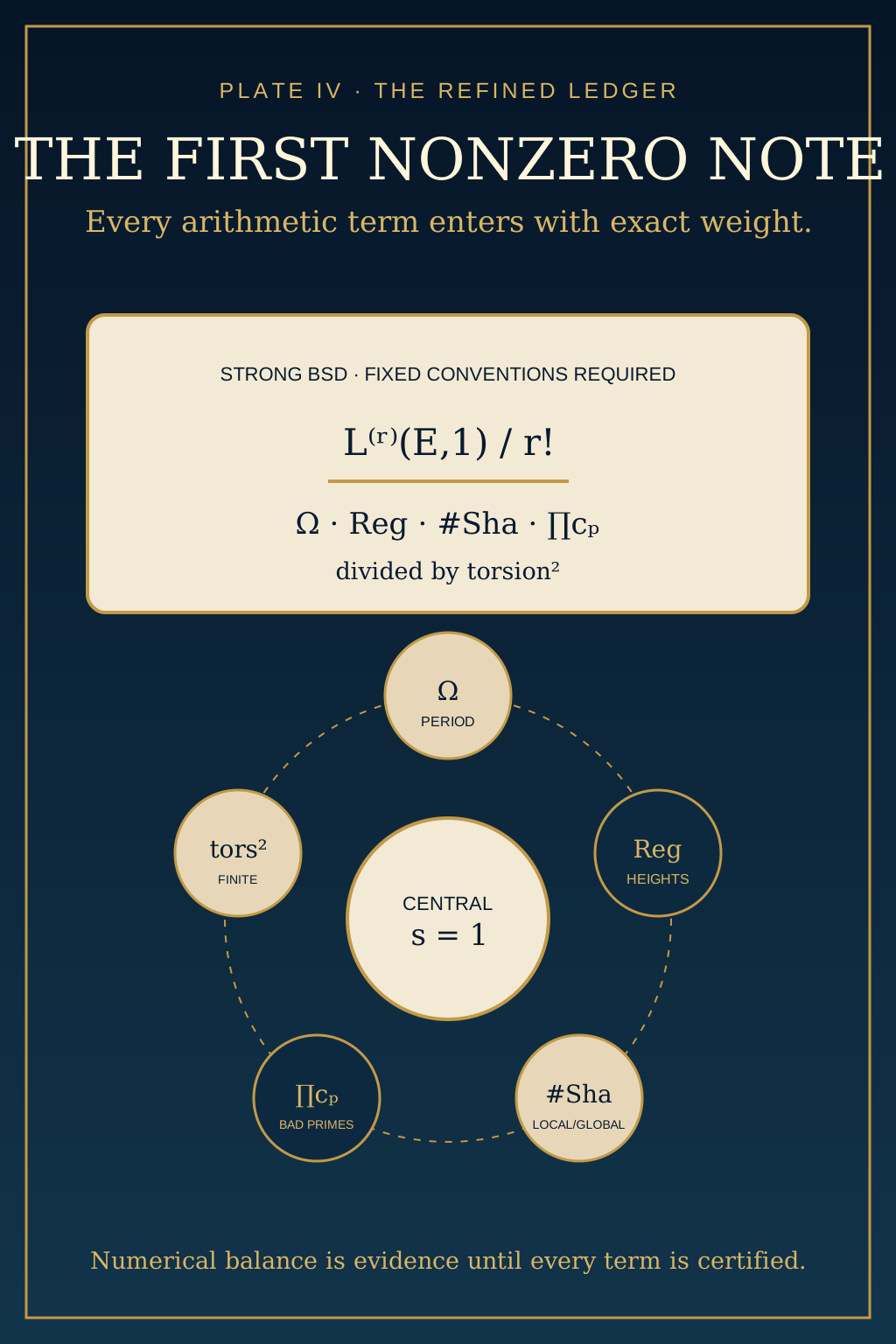
Plate IV. Plate IV The strong BSD ledger Fallback predecessor plate. With JavaScript enabled, the reviewed quantified dependency successor is activated at this stable source reference. Illustration. Alt text: A decorative ledger surrounds the leading-term formula with period, regulator, Tamagawa, torsion, and Tate–Shafarevich contributions.
Chapter V
The exact theorem frontier
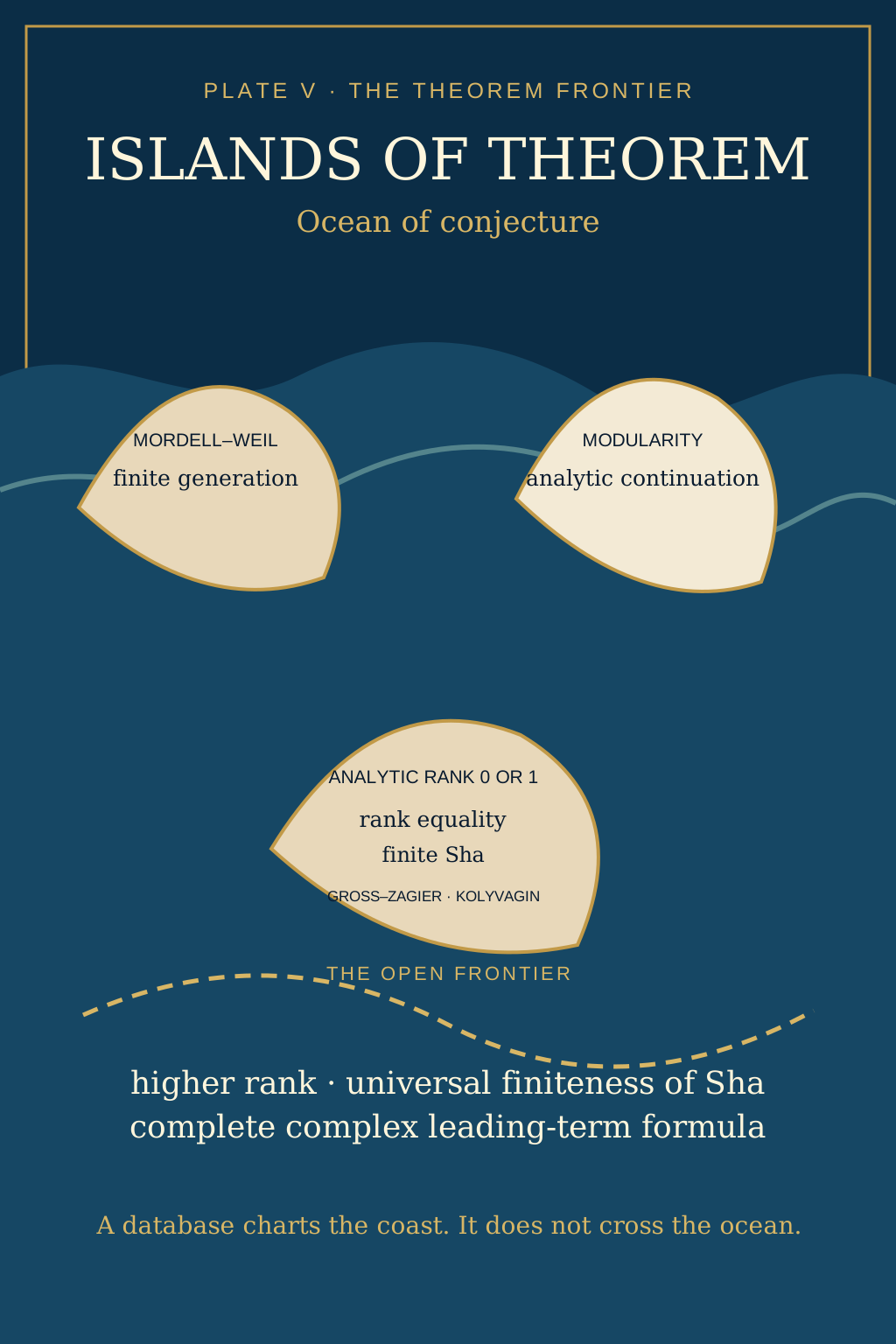
The frontier is governed by quantifiers and scope. Mordell–Weil finite generation and modularity hold for every elliptic curve over \(\mathbb{Q}\). Through modularity, Gross–Zagier, and Kolyvagin, the established analytic rank zero or one terrain gives matching algebraic rank and finite \(\mathop{\mathrm{Sha}}\).
The higher-rank and universal leading-term frontier remains open: rank equality for every elliptic curve over \(\mathbb{Q}\), general finiteness of \(\mathop{\mathrm{Sha}}\), and the complete normalized complex leading-term formula.
Established low-rank terrain
Analytic rank \(0\) or \(1\) yields the matching Mordell–Weil rank and finite \(\mathop{\mathrm{Sha}}\) for elliptic curves over \(\mathbb{Q}\).
Still open universally
For every elliptic curve over \(\mathbb{Q}\): equality of algebraic and analytic rank, finiteness of \(\mathop{\mathrm{Sha}}\), and the complete complex leading-term formula.
Plate V. Plate V Islands of theorem, ocean of conjecture Fallback predecessor plate. With JavaScript enabled, the reviewed quantified theorem-frontier successor is activated at this stable source reference. Illustration. Alt text: A map distinguishes established modularity and low-rank results from the unresolved higher-rank and universal leading-term frontier.
Technical appendix A
Elliptic curves and the Mordell–Weil group
For \(E:y^2=x^3+Ax+B\), the discriminant is \(\Delta=-16(4A^3+27B^2)\ne0\). The projective point \(O=[0:1:0]\) is the identity.
For distinct \(P=(x_1,y_1)\) and \(Q=(x_2,y_2)\) with \(x_1\ne x_2\),
Then \(P+Q=(x_3,y_3)\). Associativity belongs to the algebraic-group structure; the chord picture alone is not its proof.
For a basis \(P_1,\ldots,P_r\) of the free part, the canonical height pairing gives
with empty determinant \(1\) when \(r=0\).
Technical appendix B
The \(L\) -function and analytic rank
The Euler product converges absolutely initially for \(\mathop{\mathrm{Re}}(s)>3/2\). Modularity identifies it with the \(L\) -series of a weight-two newform. A standard completed normalization is
satisfying \(\Lambda(E,s)=w_E\Lambda(E,2-s)\). The analytic rank is
The root number gives \((-1)^{r_{\mathrm{an}}}=w_E\). This is analytic parity; it is not by itself algebraic rank equality.
Technical appendix C
The strong formula and normalization discipline
Authors distribute real periods, archimedean factors, completed-function terms, and local conventions differently. A comparison must reconcile those conventions before comparing symbols or numbers.
Normalization guardrail
A missing period component, factorial, torsion square, bad-prime factor, or completed-function term can create a false disagreement—or a false proof. Symbol matching is not normalization matching.
The phrase “BSD is true for this curve” must identify whether it means rank equality, finite \(\mathop{\mathrm{Sha}}\), the full complex leading term, a \(p\) -part, or a computational certificate for a fixed curve.
Technical appendix D
Selmer groups, descent, and the hidden term
Kummer theory yields
For a prime \(p\),
Descent converts an infinite search into finite covering and local-solubility problems and can give an upper bound on rank. The bound is sharp only after the relevant Tate–Shafarevich contribution is controlled.
Selmer guardrail
Selmer corank is not automatically Mordell–Weil rank. A nontrivial \(p\) -primary Tate–Shafarevich contribution may remain.
Technical appendix E
Known results and claim-level trust matrix
| Claim | Trust class | Qualification |
|---|---|---|
| \(E(\mathbb{Q})\) is finitely generated | established | Mordell–Weil theorem |
| Every elliptic curve over \(\mathbb{Q}\) is modular | imported established | supplies continuation and functional equation |
| Analytic rank \(0\) or \(1\) gives matching algebraic rank and finite \(\mathop{\mathrm{Sha}}\) | imported established | exact low-rank terrain |
| Universal rank equality | open | no finite computation, parity theorem, or family result promotes it |
| Universal finiteness of \(\mathop{\mathrm{Sha}}\) | open | separate from rank equality |
| Universal complex leading-term formula | open | requires every normalization and arithmetic factor |
| A fixed-curve rigorous computation | bounded evidence or certificate | does not imply the universal statement |
| A \(p\) -adic or one-prime theorem | hypothesis-sensitive theorem terrain | not identical to the global complex formula |
| Exact-object documentary plates | pedagogical | reproducible representation; never proof evidence |
Final claim boundary
This web edition changes presentation, not theorem strength. It does not prove BSD, provide a new reduction, independently verify the complete literature, or make a novelty or priority claim.
Sources and programme crosswalk
Governing literature and campaign record
Andrew Wiles, The Birch and Swinnerton–Dyer Conjecture, official Millennium Problem description.
B. J. Birch and H. P. F. Swinnerton-Dyer, “Notes on elliptic curves II” (1965).
Christophe Breuil, Brian Conrad, Fred Diamond, and Richard Taylor, “On the modularity of elliptic curves over \(\mathbb{Q}\)” (source) (2001).
Benedict Gross and Don Zagier, “Heegner points and derivatives of \(L\) -series” (source) (1986).
V. A. Kolyvagin and D. Yu. Logachev, “Finiteness of the Shafarevich–Tate group and the group of rational points for some modular abelian varieties” (1989/1990).
Clay Mathematics Institute: Birch and Swinnerton–Dyer Conjecture.
Programme links: Domain 04 · canonical master plan · campaign artifacts · review records
Edition record
This browser edition uses exact-object-first visual pedagogy. The revised BSD plate sequence is bound to a Wolfram Language semantic master, deterministic static delivery assets, and the stable-source activation resolver.
The web edition is derivative. The committed pointer is a source record; the checksum-locked complete illustrated source bundle is the authoritative source artifact. MathJax 3.2.2 is a version-pinned network enhancement, and the source TeX remains present when it is unavailable.
Web claim boundary: Browser-native, source-normalized exposition of rational points, the Mordell–Weil group, the Hasse–Weil L-function, low-rank theorem terrain, and the strong BSD formula. Numerical agreement, parity, Selmer bounds, family results, one-prime theorems, and p-adic analogues are not promoted to the universal complex conjecture.
Web-edition dataReusable schemaSource recordArtifact manifest
Rendered PDF
16,582,087 bytes ·
36254378e11fd22a067944838341ae04fedbd13e5ea588180023874d7ba49ce9
·
metadata_only
Complete LaTeX source
50,500 bytes ·
9b7b95702a5305c51e66e026d44ddf3003029808edb3009ed1b2fcbc92e6b2b4
·
metadata_only
Authoritative complete illustrated source bundle
16,995,210 bytes ·
c0782575453227311630e17c443a4dea08091b3a3824bc23a1af17f5bd0d8377
·
metadata_only